




Should I Start with ₹500… or ₹5,000?
You’ve finally decided to begin your investment journey.
-> You open a mutual fund app.
-> You choose a fund.
-> You tap “Start SIP.”
-> Then the app asks one simple question:
“How much would you like to invest every month?“
Suddenly, the excitement turns into confusion.
- Is ₹500 too little?
- Should I invest ₹2,000 instead?
- What if ₹5,000 becomes difficult next month?
- What if I choose the wrong amount?
These are completely normal questions.
In fact, they’re among the most common concerns for people starting their very first SIP.
Many beginners believe there must be a “perfect” monthly amount that everyone should invest.
The truth is much simpler.
There is no magic SIP number that works for everyone.
The right amount depends on your income, expenses, responsibilities, financial goals, and ability to invest consistently over time.
This guide will help you understand how to decide your monthly SIP amount using a practical step-by-step approach, without complicated financial jargon or unrealistic promises.
By the end of this article, you’ll know:
- ✔ How to choose a comfortable SIP amount
- ✔ Why starting small is perfectly okay
- ✔ How your goals influence your investment
- ✔ Mistakes that beginners should avoid
- ✔ When and how to increase your SIP
Let’s start with the most important question.
Is There a Perfect SIP Amount?
Short Answer: No.
If you ask ten experienced investors how much you should invest every month, you may receive ten different answers.
That’s because personal finance is exactly that—personal.
Although Rahul and Priya earn the same salary, expecting both to invest the same SIP amount wouldn’t make sense.
Their financial situations are completely different.
That’s why the ideal SIP amount is never based on income alone.
It should reflect your overall financial picture.
Although Rahul and Priya earn the same salary, expecting both to invest the same SIP amount wouldn’t make sense.
Their financial situations are completely different.
That’s why the ideal SIP amount is never based on income alone.
It should reflect your overall financial picture
Remember this simple rule:
Never copy someone else's SIP amount. Your friend's investment may suit their income, goals, and responsibilities—but not necessarily yours.
What Actually Decides Your SIP Amount?
Instead of asking,
“How much should I invest?”
Ask yourself:
“How much can I comfortably invest every month without affecting my daily life?”
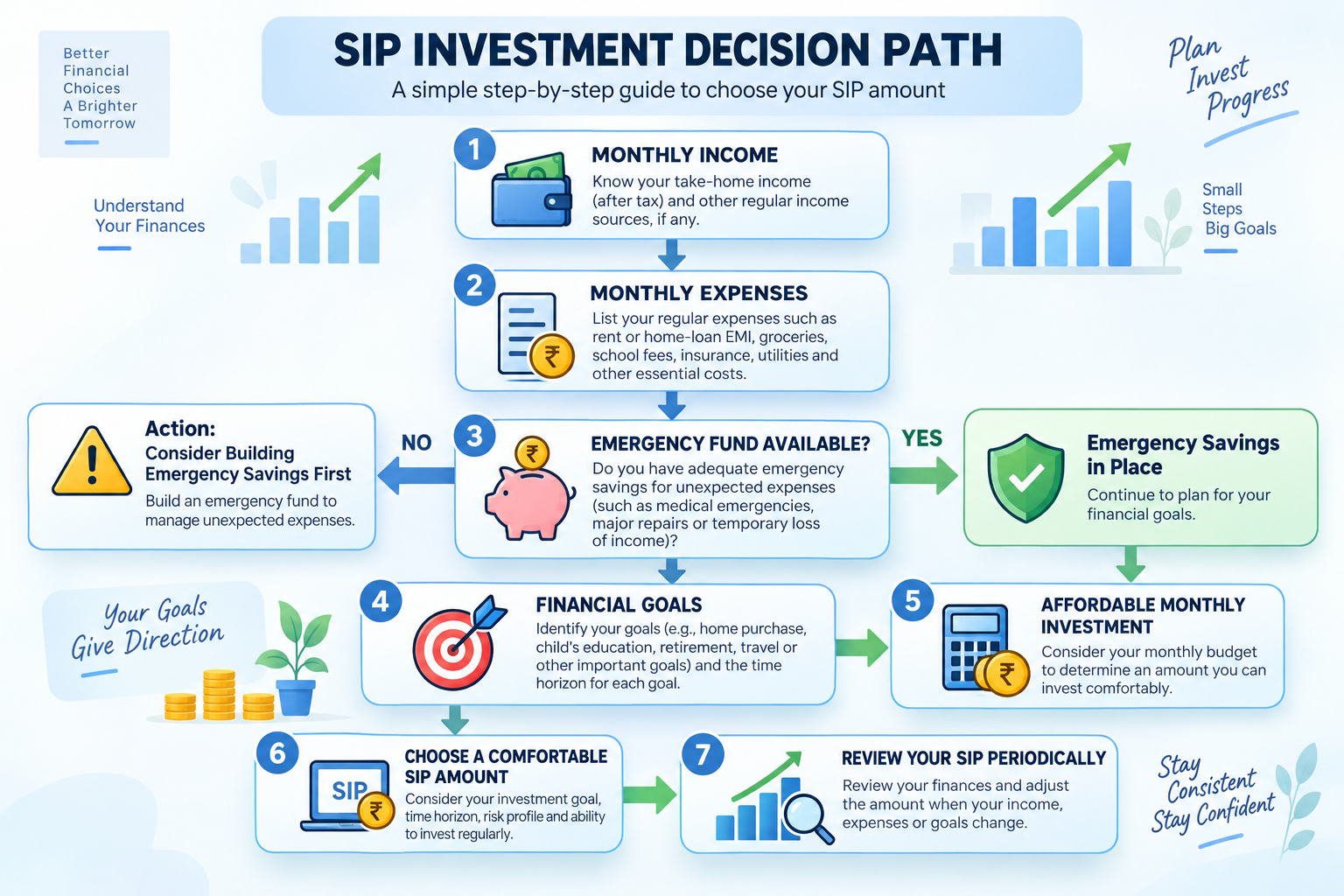
Your answer depends on five important factors.
Arjun earns ₹35,000 per month.
Initially, he planned to start a ₹5,000 SIP because his friends were investing similar amounts.
After reviewing his monthly expenses, he realized he could comfortably invest only ₹1,500 without affecting his household budget.
Instead of postponing investing, he started with ₹1,500.
A year later, after receiving a salary increment, he increased his SIP to ₹2,500.
The important lesson?
He built the habit first and increased the amount later.
Key Takeaway
Choosing your monthly SIP amount isn't about finding a number that impresses others.
It's about selecting an amount that:
- Fits your budget
- Supports your goals
- Allows you to sleep peacefully
- Can be maintained consistently over the long term
That's the foundation of disciplined investing.
Understanding Your Monthly Budget
Before Starting a SIP
Have you ever thought,
“I want to invest every month…
but I’m not sure how much I can actually afford?”
If yes, you’re not alone.
Many beginners make the mistake of deciding a SIP amount first and thinking about
their monthly expenses later.
Unfortunately, this approach often leads to one of two problems:
- They choose an amount that’s too high and struggle to continue.
- They invest too little even though they could comfortably save more.
Neither situation is ideal.
Before deciding your SIP amount, it’s important to understand one simple principle:
Your SIP should fit comfortably into your
monthly budget—not compete with it.
Think of your monthly income as a pie.
Every month, that income is divided into different categories:
- Household expenses
- Rent or home loan EMI
- Groceries
- Children’s education
- Insurance premiums
- Utility bills
- Emergency savings
- Investments
Your SIP should come from the money available after taking care of your essential financial responsibilities.
When your budget is balanced, investing becomes much easier—and much less stressful.
A Simple Budget Framework Anyone Can Follow
You don't need complicated spreadsheets or finance apps to decide your SIP amount.
A simple five-step budgeting exercise is enough.
Don't Forget Emergency Savings
Life rarely goes exactly as planned. Unexpected situations can arise at any time: Medical emergencies Vehicle repairs Temporary job loss Home maintenance Family emergencies This is why having an emergency fund is so important. If you haven't started building one yet, consider setting aside a small amount every month before increasing your SIP significantly. An emergency fund provides financial stability and reduces the need to interrupt long-term investments during difficult times.
Think of your emergency fund as your financial safety net. A SIP helps you build wealth over time. An emergency fund helps you handle life's unexpected events without disturbing your investments. Both are important.
Why Starting with ₹500 Is Better Than Waiting
One of the biggest myths among beginners is:
“I’ll start investing once I can afford ₹5,000 every month.”
In reality, waiting for the “perfect” amount often delays investing for months—or even years.
Many mutual fund schemes allow SIPs to begin with amounts as low as ₹100 or ₹500.
Starting with a smaller amount has several advantages:
- You develop the habit of investing regularly.
- You become comfortable with market movements.
- You learn how SIPs work through real experience.
- You can increase your investment later as your income grows.
Remember:
Consistency is often more important than the amount you start with.
Real-Life Examples
Every investor's journey is different.
Let's look at a few examples to understand how the "right" SIP amount can vary depending on individual circumstances.
Fresh Graduate
Age: 23
Take-home Salary: ₹28,000
No loans
Living with parents
Goal
Build long-term wealth while developing the habit of investing.
Possible Approach
Build a small emergency fund.
Start with a ₹1,000–₹2,000 SIP, depending on monthly expenses.
Increase the SIP after each salary increment.
Key Learning
At this stage, building the investment habit is more important than investing a large amount.

Young Married Couple
-Combined Monthly Income: ₹90,000
-Home Loan EMI
-Planning for a child's future
Goals
Retirement
Child's education
Family vacation
Possible Approach
Instead of one large SIP, they may choose separate SIPs aligned with each goal and review them periodically.
Key Learning
Different goals often have different timelines and may require different investment strategies.

Self-Employed Business Owner
Monthly income varies.
Some months are excellent.
Some months are slower.
Possible Approach
Choose a SIP amount that remains affordable even during lower-income months.
If income increases significantly, consider investing additional surplus separately rather than committing to an unsustainably high monthly SIP.
Key Learning
Consistency matters more than choosing an amount based on your best month.

Parent Planning for Higher Education
Age: 38
Child's Age: 6
Goal: Higher education in approximately 12 years.
Possible Approach
Estimate the future education goal, use a SIP calculator to understand the monthly contribution required, and review the plan periodically as circumstances change. Key Learning Long-term goals benefit from starting early and reviewing progress regularly.
Beginner's SIP Success Checklist
Before you start your SIP, make sure you can answer “Yes” to these questions:
- I know why I'm investing.
- I have identified my financial goal.
- My SIP amount fits comfortably within my monthly budget.
- I have started building an emergency fund.
- I understand that mutual fund investments are subject to market risk.
- I plan to review my SIP at least once a year.
Common Mistakes Beginners Make
Learning what not to do is just as important as knowing what to do.
Starting with an Amount That Feels Uncomfortable
A SIP should support your financial journey—not become a monthly burden.
Copying Friends or Colleagues
Just because someone else invests ₹10,000 every month doesn’t mean that amount is right for you.
Everyone has different goals, expenses, and responsibilities.
Ignoring an Emergency Fund
Without an emergency fund, unexpected expenses may force you to pause or stop your investments.
Reviewing Investments Every Day
Checking your SIP every day can create unnecessary anxiety.
Long-term investing benefits from patience and periodic reviews rather than constant monitoring.
Chasing Last Year’s Best-Performing Fund
Past performance alone should never be the only reason for selecting a mutual fund.
Understand the fund’s objective, risk level, and whether it matches your financial goals.
Frequently Asked Questions (FAQs)
1. What is the ideal SIP amount for beginners?
There isn't a universal SIP amount that works for everyone. The ideal amount depends on your income, monthly expenses, financial goals, and your ability to invest consistently.
If you're just starting, choose an amount that comfortably fits within your monthly budget. As your income grows, you can gradually increase your SIP.
2. Is ₹500 enough to start a SIP?
Yes. Many mutual fund schemes allow SIPs starting from ₹100 or ₹500.
While ₹500 alone may not achieve every financial goal, it is enough to begin developing the habit of regular investing.
3. Should I build an emergency fund before starting a SIP?
Ideally, yes.
An emergency fund helps you handle unexpected expenses without disturbing your long-term investments. If you haven't built one yet, consider starting with a small emergency fund while beginning a manageable SIP.
4. Can I increase my SIP later?
Absolutely.
Many investors increase their SIP after salary increments, bonuses, or when major financial commitments reduce. Gradually increasing your SIP allows your investments to grow alongside your income.
5. What happens if I miss one SIP installment?
Missing a single installment doesn't mean your investment journey has failed.
However, frequent interruptions may affect long-term investing discipline. Review your budget and restart your SIP whenever your financial situation improves.
6. Should I stop my SIP when markets fall?
Market fluctuations are a normal part of investing.
SIPs are designed to invest regularly through different market conditions, reducing the need to predict market movements. Before making decisions during market volatility, review your financial goals and seek professional guidance if required.
7. How often should I review my SIP?
Review your SIP once or twice every year.
You should also review your investments after major life events such as marriage, the birth of a child, salary increments, or buying a house.
8. Is it better to have one SIP or multiple SIPs?
It depends on your financial goals.
Many investors prefer separate SIPs for retirement, children's education, home purchase, or wealth creation because they are easier to track.
9. Can I pause or stop my SIP?
Many mutual fund schemes allow investors to pause or discontinue SIPs, subject to the scheme's terms and conditions.
Before stopping a SIP, evaluate whether the reason is temporary or long-term and understand how it may affect your financial goals.
10. Do SIPs guarantee returns?
No.
A SIP is only a method of investing. Mutual fund investments are subject to market risks, and returns are not guaranteed.
💡 Quick Reminder
The best SIP amount is not the biggest one.
It is the amount you can comfortably invest every month while managing your household expenses and working towards your financial goals.
Final Thoughts
Starting a SIP doesn't require perfect timing.
It doesn't require a high salary.
And it certainly doesn't require you to understand every stock market concept before taking your first step.
What matters most is building the habit of investing regularly.
Whether you begin with ₹500, ₹2,000, or ₹5,000, ask yourself one simple question:
"Can I comfortably continue this investment every month while managing my other financial responsibilities?"
If the answer is yes, you're already moving in the right direction.
Remember, successful investing is rarely about making perfect decisions.
It's about making informed decisions consistently over the long term.
Ready to Take the Next Step?
If you're planning to begin your SIP journey, use our SIP Calculator to estimate the monthly investment required for your financial goals.
If you need help understanding the results, we're here to guide you with simple, educational, and goal-based investment planning.
Try Our SIP Calculator →Continue Learning
About the Author
Boopathi Giri
AMFI Registered Mutual Fund Distributor (ARN-285043)
Boopathi Giri helps individuals and families understand mutual funds, SIPs, and goal-based investing through simple, educational content. His mission is to simplify investing so that beginners can make informed financial decisions with confidence.
Disclaimer
This article is intended for educational purposes only and should not be considered investment, financial, or tax advice.
Mutual Fund investments are subject to market risks. Read all scheme-related documents carefully before investing.
Please consult a qualified financial or tax professional before making investment decisions based on your individual circumstances.
Quick Summary
- There is no universal "perfect" SIP amount.
- Choose a SIP based on your income, expenses, and financial goals.
- Build an emergency fund alongside your investments.
- Start with an amount you can comfortably continue.
- Review and increase your SIP as your income grows.


Add a Comment